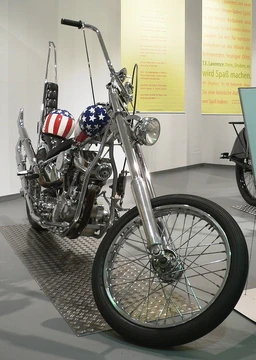
Honda CB750
First superbike (disputed); original Universal Japanese Motorcycle.

Rachel.dicerbo · CC BY-SA 4.0
The CR750 is a production-based racer derived from the CB750, not a bespoke factory-only design.
- Known for
- First superbike (disputed); original Universal Japanese Motorcycle
- Notable variants
- CR750 production-based racer; CB750A Hondamatic
Lore & Background
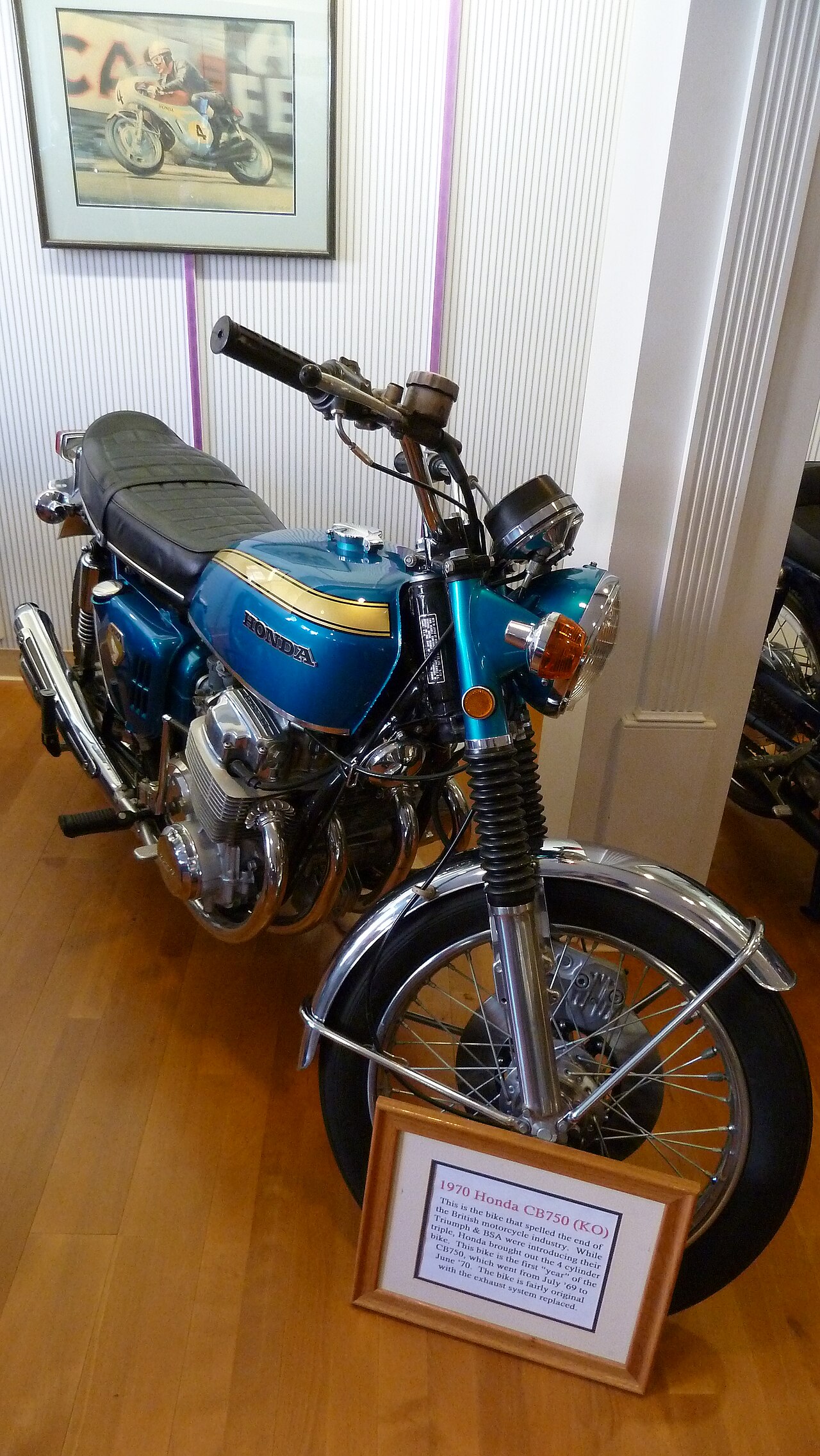
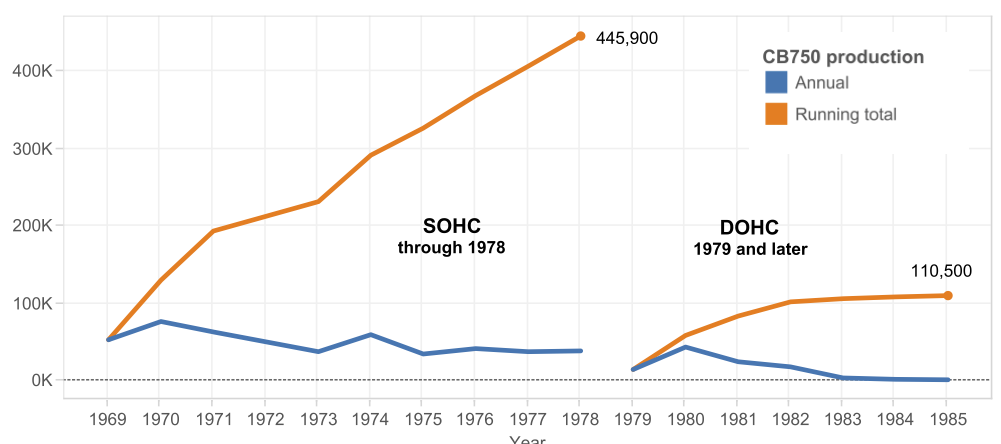
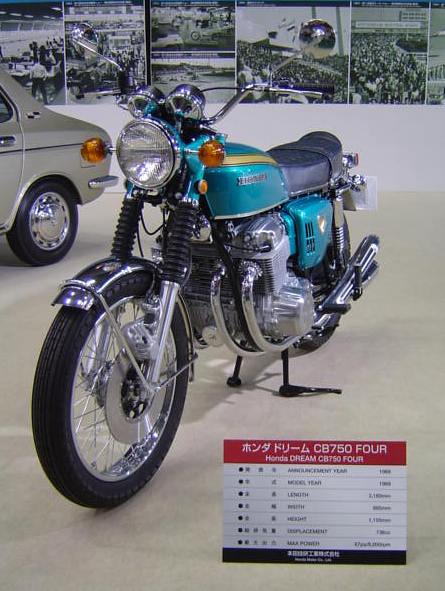
Honda introduced the CB750 to US and European markets in 1969 after success with smaller motorcycles. The CB750 had a transverse straight-four engine with a single overhead camshaft and a front disc brake, neither previously available on an affordable mainstream production motorcycle. Cycle magazine called it 'the most sophisticated production bike ever' at the time of introduction.
Reader's Guide
The CB750 popularized the transverse, overhead camshaft, inline four-cylinder engine configuration, which subsequently became the dominant sport bike engine layout. It is included in the AMA Motorcycle Hall of Fame Classic Bikes, named in Discovery Channel's 'Greatest Motorbikes Ever', featured in The Art of the Motorcycle exhibition, and held in the UK National Motor Museum.
Did You Know?
- The CB750 is often called the first 'superbike', though the term's first use is disputed.
- The CB750A Hondamatic had a two-speed semi-automatic transmission where the rider manually shifted between low and high range, but the torque converter handled clutch engagement automatically.
From Prototype to Purpose: The Design Journey
Shoichiro Irimajiri, a veteran who had shaped Honda's multi-cylinder Grand Prix engines and even their Formula One V12 during the 1960s, took the helm. The team broke from company convention by building an experimental machine dubbed the M1, featuring a longitudinal engine layout and shaft final drive rather than the transverse, chain-driven arrangement Honda typically used. The extreme length of the engine-and-gearbox assembly created an uncomfortable, cramped riding position, prompting the team to pivot toward a more compact one-liter flat-four. Crucially, the team had initially conceived the Gold Wing as a large sport motorcycle, but after discovering that riders were accumulating serious touring mileage, they fundamentally reoriented the design toward long-distance comfort and endurance.
Engineering That Redefined the Category
The powerplant was a liquid-cooled flat-four with a single overhead cam, and its cylinder blocks were cast integrally with the crankcase to minimize overall length. The transmission sat directly beneath the crankcase, keeping the unit-construction engine as compact as possible while still delivering smooth, torque-rich performance. One of the most elegant touches was the gear-driven generator, which was set to contra-rotate in order to cancel out the engine's torque reaction, reducing vibration and improving ride quality. The design drew on technologies inherited from both earlier Honda motorcycle work and the company's automotive engineering.
Carving Out a Touring Niche
When Honda's engineers set out to define the Gold Wing's buyer, they looked at the early-1970s American touring landscape and found a fragmented field. The other Japanese options, including the CB750 itself and the Kawasaki Z1, were more affordable but suffered from small fuel tanks and rear drive-chains that demanded frequent maintenance, making them poor long-haul companions. Honda identified a gap: a new breed of American long-distance rider who would not gravitate toward a Harley or a BMW but who would gladly invest in a machine offering genuine comfort, endurance, low upkeep, and a quiet, torquey engine. The Gold Wing was engineered to deliver wind protection, a plush seat, ample luggage storage, and abundant power. Europe served as a secondary market, where riders valued handling and performance over luxury, a demand that eventually spawned the separate Honda Pan European. No other touring motorcycle has matched the Gold Wing's sustained popularity across decades.
Common Misconceptions (Editorial)
- Some believe the CB750 was a bespoke factory-only racing machine, but it was actually a production-based racer derived from the standard CB750, as seen in the CR750 variant. - The term "first superbike" is often confidently applied to the CB750, but the facts note that this designation is disputed. - It is sometimes assumed the CB750A Hondamatic was a fully automatic transmission, when in reality it had a two-speed semi-automatic system requiring the rider to manually shift between low and high range.
Why It Matters (Editorial)
The Honda CB750 endures as a landmark because it brought advanced technology—a transverse four-cylinder engine and front disc brake—to an affordable mainstream audience, democratizing performance that was once reserved for exotic or expensive machines. Its influence shaped the Universal Japanese Motorcycle category and sparked the superbike era, making it a touchstone for how innovation can redefine an entire industry.
Gallery
Frequently Asked Questions
What does 'Universal Japanese Motorcycle' have to do with the CB750?
The CB750 is frequently cited as the original UJM because it was the first Japanese motorcycle to compete head-to-head with European sport bikes in speed, handling, and touring all at once. It set the benchmark that other Japanese manufacturers then followed throughout the 1970s.
What is the CR750 and how does it differ from the CB750?
The CR750 is a racing variant derived directly from the production CB750 platform rather than being a wholly separate, factory-only design. It shares the same fundamental mechanical DNA as the street-legal model while being tuned for competition.
More in Iconic Motorcycles 1-20
Spotted an error? Know more?
This is a living reference — every entry is fact-audited, and reader corrections feed straight into our audit queue. Suggest an edit · See this site's audit record